Every time your smartwatch measures your heart rate, your car’s engine management system adjusts fuel injection, or your laptop converts a voice into a Teams call — there’s a specific type of chip making it happen. Not a purely digital chip. Not a purely analog one. Something in between, doing both jobs at once.
That chip is a mixed-signal IC — and it’s arguably the most underappreciated category of integrated circuit in modern electronics. It’s everywhere, it’s critical, and most engineers outside the analog world don’t fully understand what’s happening inside it.
This guide breaks down what a mixed-signal IC actually is, how it works internally, where it’s used across industries, and what makes designing one genuinely difficult.
What Is a Mixed-Signal IC?
A mixed-signal IC (mixed-signal integrated circuit) is a semiconductor device that contains both analog and digital circuitry on the same silicon die. It processes real-world analog signals — voltage, current, temperature, pressure, light — and converts them to or from digital data that a processor can work with.
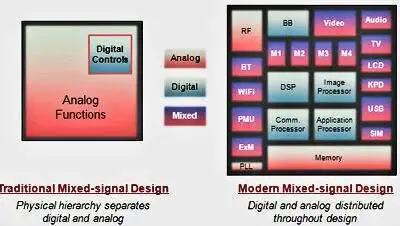
The word ‘mixed’ here is literal: the die has analog blocks (amplifiers, voltage references, oscillators, PLLs) sitting right next to digital blocks (logic gates, registers, state machines, DSP cores), all sharing the same substrate and often the same power supply rail.
This co-integration is what makes them powerful — and what makes them genuinely challenging to design.
How Does a Mixed-Signal IC Work?
The physical world is analog. Temperature doesn’t jump from 25°C to 26°C in discrete steps — it changes continuously. Sound is a continuous pressure wave. A battery’s voltage gradually declines. None of this is naturally digital.
But modern processors — microcontrollers, DSPs, FPGAs, application processors — only understand binary: ones and zeros. A mixed-signal IC bridges that gap.
The Analog Side
The analog portion handles the real-world interface:
- Amplifiers — boosting weak sensor signals (a thermocouple output can be just millivolts) to a usable level
- Voltage references — providing stable, accurate reference points for measurement
- Filters — removing noise and unwanted frequency components before digitization
- Oscillators and PLLs — generating and conditioning clock signals
- Comparators — making threshold decisions before a full ADC conversion is needed
The Digital Side
Once the signal has been conditioned, the digital blocks take over:
- ADC (Analog-to-Digital Converter) — samples the conditioned analog signal and produces a binary number
- DSP cores — process the digital data (filtering, FFT analysis, error correction)
- Digital logic and control — manages timing, sequencing, and communication with the host processor
- DAC (Digital-to-Analog Converter) — converts digital data back to analog for outputs like audio or motor control
Where They Meet: The Data Converter
The ADC and DAC are the heart of any mixed-signal IC. A 16-bit ADC can resolve signals to 1 part in 65,536. A 24-bit ADC? One part in 16,777,216. The difference matters enormously in precision instruments, audio equipment, and medical devices.

Key Components Inside a Mixed-Signal IC
| Component | Function | Example Use |
| ADC | Converts analog signal to digital | Sensor readout, audio capture |
| DAC | Converts digital to analog signal | Audio output, motor control |
| PGA | Programmable gain amplification | Adapting to different sensor ranges |
| Voltage Reference | Stable reference for ADC/DAC accuracy | Precision measurement |
| LDO / DC-DC | On-chip power regulation | Powering analog and digital sections |
| PLL | Clock generation and multiplication | USB, Ethernet, RF timing |
| Oscillator | On-chip clock source | Reducing external component count |
| Comparator | Threshold detection | Fast response circuits |
| Op-Amp | Signal conditioning, filtering | Sensor interface, audio |
| Digital Core / DSP | Signal processing | FFT, filtering, control algorithms |
Mixed-Signal IC vs. Pure Analog vs. Pure Digital
Pure Analog ICs process signals entirely in the continuous analog domain — op-amps (LM741, TL072), voltage regulators (LM317), comparators (LM393). No digital logic, no ADC anywhere on the die.
Pure Digital ICs operate entirely in the binary domain — logic gates, flip-flops, microprocessors, FPGAs, memory chips. They process ones and zeros, nothing continuously variable.
Mixed-Signal ICs do both. They contain analog and digital circuitry on the same die, with explicit conversion between the two domains inside.
Why this distinction matters:
- Design methodology differs — requires simultaneous expertise in analog and digital disciplines plus managing their interaction
- Layout rules are stricter — digital switching noise must not corrupt sensitive analog signals sharing the same die
- Test complexity is higher — requires both analog test equipment and digital test infrastructure
Real-World Examples of Mixed-Signal ICs
Audio Codecs
An audio codec IC — like the Texas Instruments PCM3168 or Cirrus Logic CS4272 — takes microphone audio (analog), converts it to digital (ADC), processes it, and converts digital audio back to analog for speaker output (DAC). Every laptop, USB audio interface, and smart speaker has one.
PMIC (Power Management IC)
A PMIC like the Qualcomm PM8150 integrates multiple DC-DC converters, LDOs, battery charger logic, fuel gauge ADC, and a digital I2C/SPI control interface. It monitors and regulates analog power rails while communicating digitally with the application processor.
Analog Front End (AFE) for Sensors
An AFE IC like the Texas Instruments ADS1299 for EEG measurement amplifies tiny bioelectric signals in the microvolt range, filters them, and converts them to high-resolution digital data. The AFE is almost always a mixed-signal IC.
Wireless Transceiver ICs
An RF transceiver like the Silicon Labs EFR32 integrates a digital processor, RF analog front end, ADC for signal demodulation, DAC for signal generation, and digital protocol stacks (Zigbee, Bluetooth) — all on one die.
Motor Control ICs
Gate driver ICs like the Texas Instruments DRV8353 combine high-voltage gate driving (analog) with SPI communication and fault reporting (digital). The ADC monitors motor current in real time while the digital block reports status to the MCU.
Industry Applications of Mixed-Signal IC
Consumer Electronics
Your smartphone contains dozens of mixed-signal ICs. The PMIC managing battery charging. The audio codec converting voice to digital. The image signal processor reading the camera sensor. The touch controller converting finger pressure to digital coordinates. The USB-C controller negotiating charging protocols digitally while managing power switching in the analog domain.
Automotive Electronics
Battery monitoring ICs like the TI BQ76952 in EV battery management systems monitor individual cell voltages with high-accuracy ADCs while communicating over SPI or SMBus. ADC resolution directly affects state-of-charge estimation accuracy — which directly affects range prediction.
All automotive mixed-signal ICs must meet AEC-Q100 Grade 0 or Grade 1 — surviving temperatures from -40°C to 150°C with extreme reliability requirements.
Medical and Healthcare
A pulse oximeter IC like the Maxim MAX86150 drives LED emitters at precise analog currents, captures photodetector signals with a 19-bit ADC, and outputs digital heart rate and SpO2 data. ECG and EEG acquisition ICs operate at the microvolt level — the analog noise floor must be extraordinarily low.
Industrial and IoT
Smart sensor ICs integrate a high-resolution ADC, digital compensation for sensor nonlinearity and temperature drift, EEPROM for calibration data, and a digital communication interface. IoT nodes like the STM32, Nordic nRF52, and ESP32 are themselves mixed-signal ICs.
Telecommunications
Clock and timing ICs in telecom infrastructure take reference clock inputs (analog), clean them with PLLs and jitter attenuators, and output precisely timed digital clocks. 5G base station timing requires sub-nanosecond accuracy — mixed-signal precision at its most demanding.
Design Challenges in Mixed-Signal ICs
- Noise coupling between domains — digital switching injects current spikes that corrupt sensitive analog circuitry; managed via guard rings, substrate isolation, and careful decoupling
- Power supply design — analog sections need cleaner, better-regulated supply than digital; separate AVDD and DVDD supply pins are standard practice
- Matching between analog elements — ADC/DAC accuracy depends on tight matching of internal resistors and capacitors; process variation must be managed by design and calibration
- Test cost — testing a 16-bit ADC requires better than 16-bit accuracy ATE; the most expensive category of semiconductor test equipment
- Design tool fragmentation — analog relies on manual layout and SPICE simulation while digital has mature automated flows; bridging both requires multidisciplinary teams
Future Trends in Mixed-Signal IC Design
- Higher integration on advanced nodes — FinFET processes (7nm, 5nm) being adapted for analog content, enabling complete system integrations on one advanced-node die
- AI-assisted analog design — machine learning tools from Synopsys and Cadence accelerating circuit sizing and layout optimization
- Software-defined analog — programmable analog ICs reconfigurable in the field via digital control, building on PSoC concepts across specialized domains
- Ultra-low-power for IoT — nanoamp standby current, energy harvesting support, and efficient sensor processing for trillion-node IoT deployments
- 5G and mmWave RF integration — phased array beamforming chips with dozens of analog RF channels and digital beamforming control; the most complex mixed-signal challenge of the decade
Key Takeaways
- A mixed-signal IC integrates both analog and digital circuitry on one silicon die, bridging the physical world and digital processing systems
- The ADC and DAC are the critical conversion elements — their resolution and performance determine overall system quality
- Mixed-signal ICs appear in virtually every electronic product: smartphones, EVs, medical monitors, industrial sensors, 5G base stations
- Design complexity is high — noise isolation, power supply management, and element matching are the core challenges
- PMICs, audio codecs, AFEs, wireless transceivers, and motor control ICs are the most common categories
- Future growth is driven by 5G, EV battery management, IoT edge nodes, and integration of analog onto advanced digital process nodes
- When selecting a mixed-signal IC, evaluate ADC/DAC resolution, SNR, PSRR, separate supply requirements, and qualification level
Conclusion
The mixed-signal IC sits at the intersection of two worlds — and in doing so, it enables almost every smart, sensing, communicating device we use today. From the EEG machine monitoring brain activity in an ICU to the audio DAC in your headphones, these chips are doing something genuinely difficult: processing the messy, continuous analog world accurately enough to satisfy digital precision.
Understanding what a mixed-signal IC is — and what determines its performance — makes you a better system designer, a more informed component buyer, and ultimately, a better engineer.
At ZerlonSemi, we source and specify mixed-signal ICs across all major categories — from precision ADCs and PMICs to full sensor AFE solutions. If you’re evaluating components for an analog-intensive design, our technical team can help you get the specifications right before you commit to a footprint.
3. FAQ Section
Q1: What does ‘mixed-signal’ mean in electronics?
‘Mixed-signal’ refers to electronic circuits or ICs that process both analog signals (continuously varying voltages or currents) and digital signals (binary ones and zeros) on the same device, with data converters (ADC/DAC) bridging the two domains.
Q2: What is the difference between a mixed-signal IC and an analog IC?
A pure analog IC processes signals entirely in the continuous analog domain — examples include op-amps, comparators, and linear regulators. A mixed-signal IC contains both analog and digital circuitry on the same die. If a chip has an ADC, DAC, or digital communication interface alongside analog functions, it is a mixed-signal IC.
Q3: What are common examples of mixed-signal ICs?
Common examples include: audio codec ICs, PMICs with digital control interfaces, microcontrollers with built-in ADC peripherals, wireless transceiver ICs (Bluetooth, Wi-Fi, Zigbee), analog front end ICs for sensors, motor control gate drivers with current sensing ADCs, and battery management ICs for EVs.
Q4: Why is mixed-signal IC design more difficult than pure digital design?
Digital switching noise can corrupt sensitive analog circuits sharing the same die. Designers must partition the layout carefully, use guard rings and substrate isolation, manage separate power domains, ensure tight matching between analog elements, and validate performance using expensive precision test equipment.
Q5: What is an ADC and why is it important in a mixed-signal IC?
An ADC (Analog-to-Digital Converter) samples an analog signal and converts it into a binary number. It is the critical interface point between the analog and digital worlds. ADC specifications — resolution (bits), sampling rate, SNR, and THD — largely determine system quality and accuracy.
Q6: What industries use mixed-signal ICs the most?
Consumer electronics (smartphones, audio, wearables), automotive (EV battery management, ADAS, engine control), medical devices (patient monitoring, diagnostics), industrial automation (smart sensors, motor drives), and telecommunications (5G base stations, optical networking, timing systems).
Q7: What should I look for when selecting a mixed-signal IC?
Key parameters: ADC/DAC resolution and sampling rate, input voltage range, SNR and THD+N, power supply rejection ratio (PSRR), separate AVDD/DVDD supply requirements, digital interface type (SPI, I2C, parallel), operating temperature range, and qualification level (commercial, industrial, AEC-Q100 automotive).
Q8: Is a microcontroller with an ADC a mixed-signal IC?
Yes, technically. Any microcontroller with integrated ADC peripherals (STM32, PIC, AVR, nRF52) is a mixed-signal device. In industry practice, engineers often distinguish between ‘microcontrollers’ and dedicated mixed-signal ICs (precision ADCs, PMICs, AFEs) even though the technical classification overlaps.